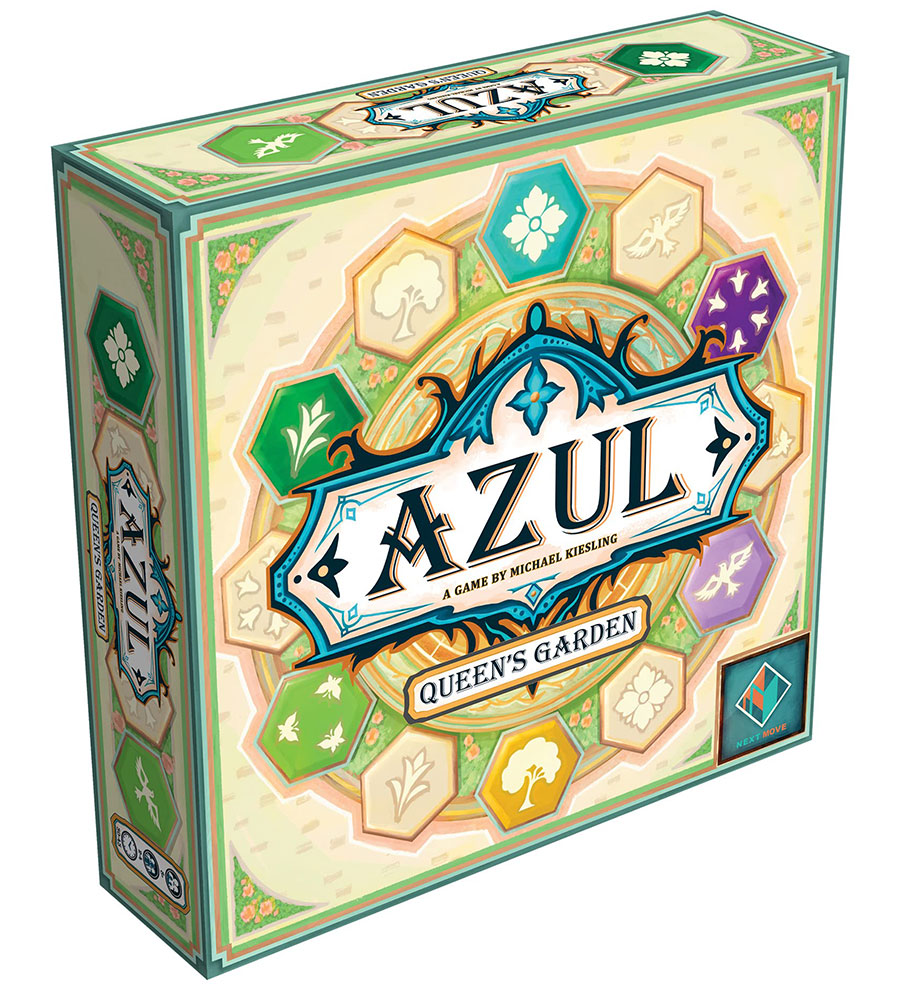
Welcome back to the palace of Sintra! King Manuel I has commissioned the best garden designers of Portugal to construct the most extraordinary garden for his wife, Queen Maria of Aragon. In Azul: Queen's Garden, players are tasked with arranging a magnificent garden for the King's lovely wife by arranging beautiful plants, trees, and ornamental features. Using an innovative drafting mechanism, the signature of the Azul series, players must carefully select colorful tiles to decorate their garden. Only the most incredible garden designers will flourish and win the Queen's blessing. —description from the publisher
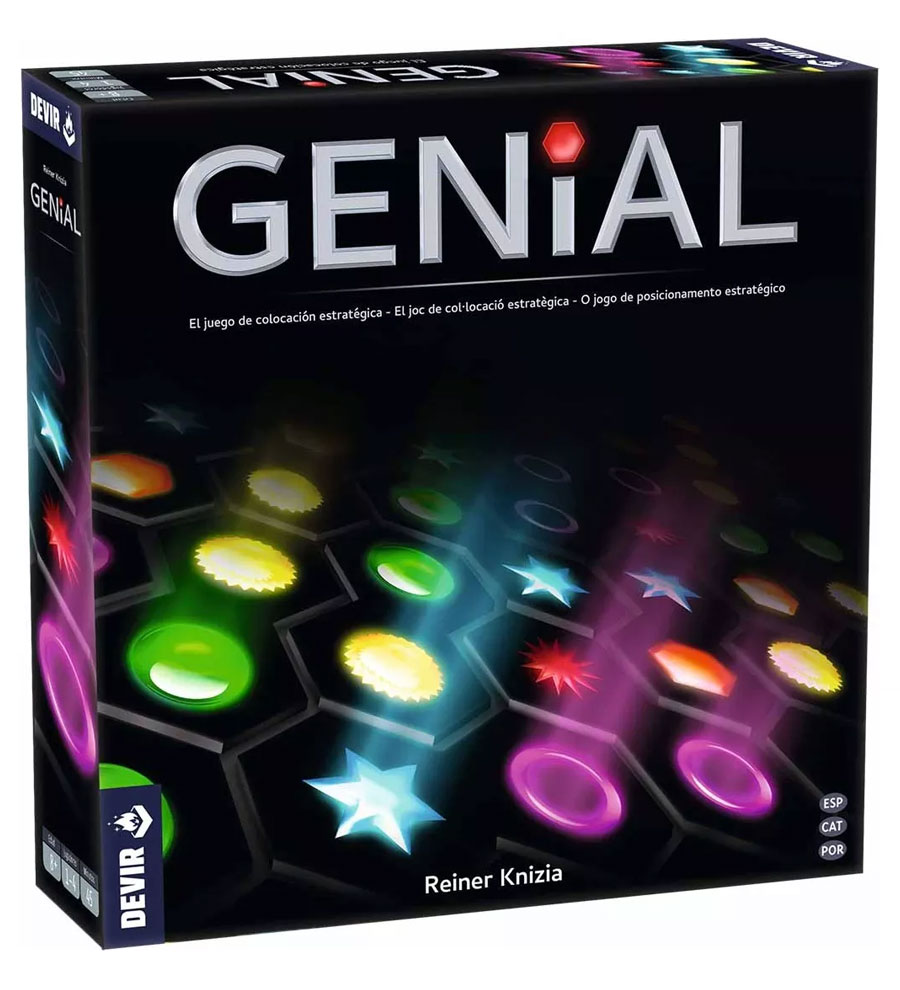
In Ingenious, a.k.a. Einfach Genial, players take turns placing colored domino-style tiles on a game board, scoring for each line of colored symbols that they enlarge. The trick, however, is that a player's score is equal to their worst-scoring color, not their best, so they need to score for all colors instead of specializing in only one or two. In more detail, the game includes 120 domino-style tiles, each consisting of two conjoined hexes; each hex has one of six colors in it, with most tiles having different-colored hexes. Each player has a rack with six tiles on it, and on a turn a player places one tile from their rack onto two hexes of the game board. For each hex on this tile, they score one point in that color for each hex of the same color that lies adjacent to it and each hex in a straight line from it. If a player brings the score of a color to 18, they immediately take another turn. At the end of their turn, they refill their rack to six tiles. (Before refilling their rack, if they have no tiles on it that contain hexes in their lowest-scoring color, they can discard all of their tiles, then draw six new tiles from the bag.) When no more tiles can be placed on the game board or when one player scores 18 in each color, the game ends. Players then compare their lowest scores, and whoever has the highest low score wins. Ingenious includes rules for solitaire and team play; in the latter case, two teams of two play, with each player not being able to see their partner's tiles and teams keeping a combined score that maxes out at 36 instead of 18.
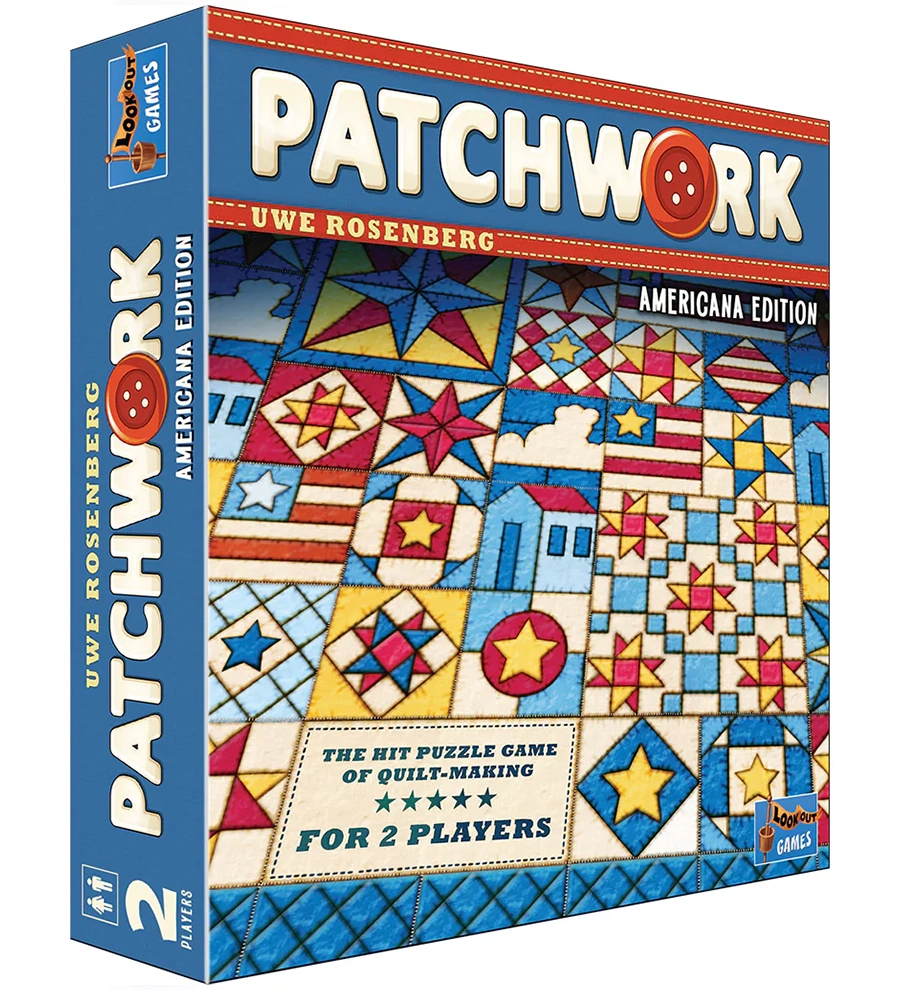
In Patchwork, two players compete to build the most aesthetic (and high-scoring) patchwork quilt on a personal 9x9 game board. To start play, lay out all of the patches at random in a circle and place a marker directly clockwise of the 2-1 patch. Each player takes five buttons — the currency/points in the game — and someone is chosen as the start player. On a turn, a player either purchases one of the three patches standing clockwise of the spool or passes. To purchase a patch, you pay the cost in buttons shown on the patch, move the spool to that patch's location in the circle, add the patch to your game board, then advance your time token on the time track a number of spaces equal to the time shown on the patch. You're free to place the patch anywhere on your board that doesn't overlap other patches, but you probably want to fit things together as tightly as possible. If your time token is behind or on top of the other player's time token, then you take another turn; otherwise the opponent now goes. Instead of purchasing a patch, you can choose to pass; to do this, you move your time token to the space immediately in front of the opponent's time token, then take one button from the bank for each space you moved. In addition to a button cost and time cost, each patch also features 0-3 buttons, and when you move your time token past a button on the time track, you earn "button income": sum the number of buttons depicted on your personal game board, then take this many buttons from the bank. What's more, the time track depicts five 1x1 patches on it, and during set-up you place five actual 1x1 patches on these spaces. Whoever first passes a patch on the time track claims this patch and immediately places it on his game board. Additionally, the first player to completely fill in a 7x7 square on his game board earns a bonus tile worth 7 extra points at the end of the game. (Of course, this doesn't happen in every game.) When a player takes an action that moves his time token to the central square of the time track, he takes one final button income from the bank. Once both players are in the center, the game ends and scoring takes place. Each player scores one point per button in his possession, then loses two points for each empty square on his game board. Scores can be negative. The player with the most points wins.


ABOUT
STORE
NEWS
CONTACT
© 2012 - 2026 • Avada is a Website Builder for WordPress and eCommerce • All Rights Reserved • Developed by ThemeFusion