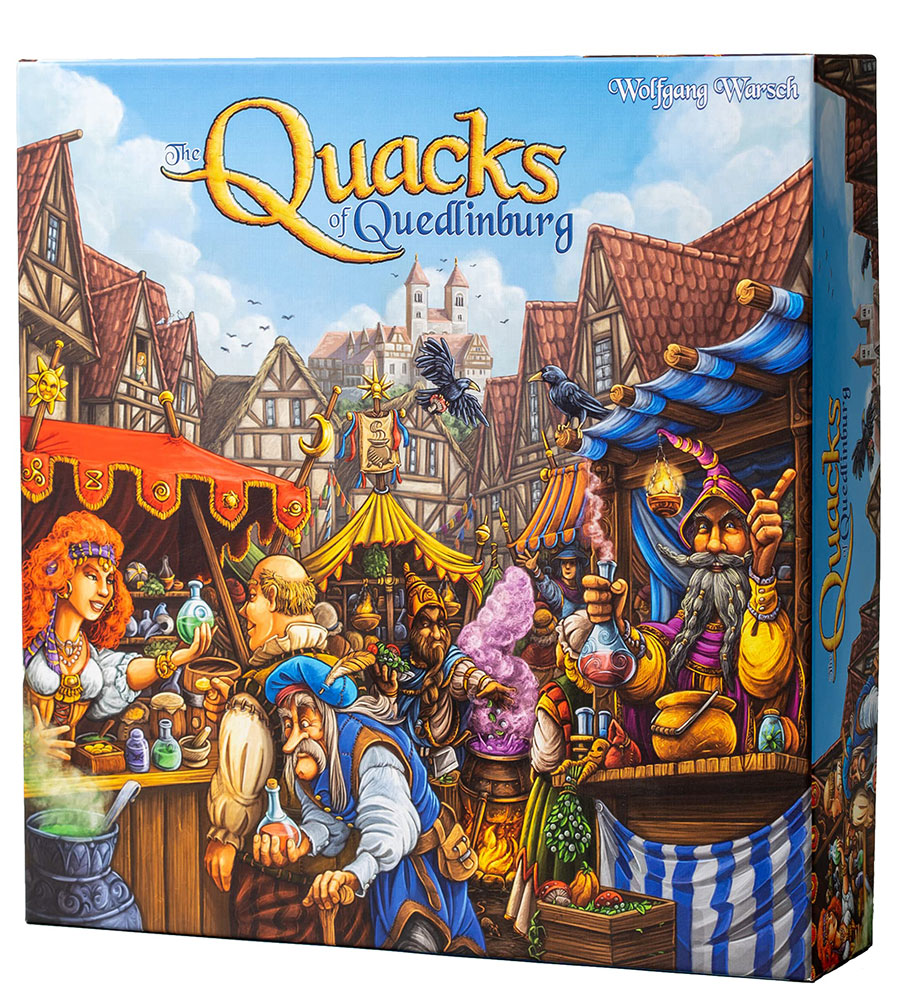
In The Quacks of Quedlinburg, players are charlatans — or quack doctors — each making their own secret brew by adding ingredients one at a time. Take care with what you add, though, for a pinch too much of this or that will spoil the whole mixture! Each player has their own bag of ingredient chips. During each round, they simultaneously draw chips from their bags and add them to their pots. The higher the face value of the drawn chip, the further it is placed in the pot's swirling pattern, increasing how much the potion will be worth. Push your luck as far as you can, but if you add too many cherry bombs, your pot will explode! At the end of each round, players gain victory points and coins to spend on new ingredients, depending on how well they managed to fill up their pots. But players whose pots have exploded must choose points or coins — not both! The player with the most victory points at the end of nine rounds wins the game.
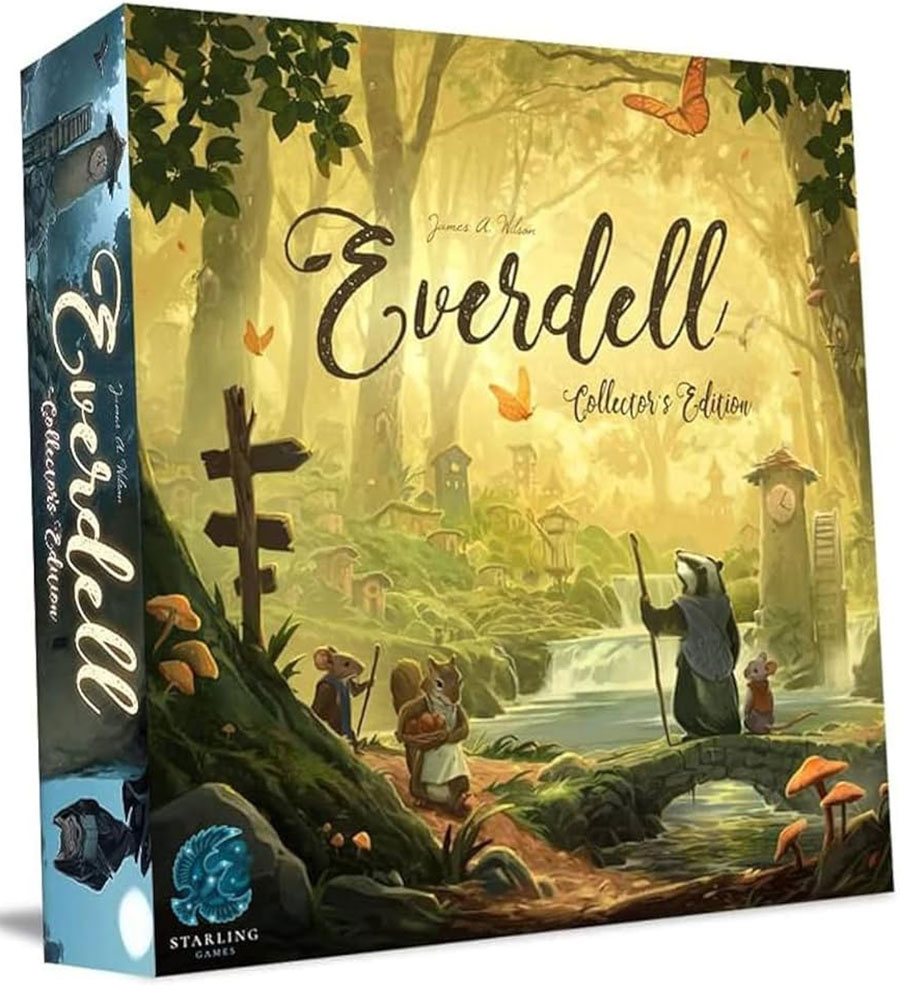
The Collector's Edition of Everdell includes everything in the standard edition, plus the 10 card Legends expansion, 15 Extra! Extra! cards, 30 metal tokens, and an upgraded 8-sided die. This is all contained in a UV spot-coated box and a Gallery slipcase.
Within the charming valley of Everdell, beneath the boughs of towering trees, among meandering streams and mossy hollows, a civilization of forest critters is thriving and expanding. From Everfrost to Bellsong, many a year have come and gone, but the time has come for new territories to be settled and new cities established. You will be the leader of a group of critters intent on just such a task. There are buildings to construct, lively characters to meet, events to host—you have a busy year ahead of yourself. Will the sun shine brightest on your city before the winter moon rises? Everdell is a game of dynamic tableau building and worker placement. On their turn a player can take one of three actions: a) Place a Worker: Each player has a collection of Worker pieces. These are placed on the board locations, events, and on Destination cards. Workers perform various actions to further the development of a player's tableau: gathering resources, drawing cards, and taking other special actions. b) Play a Card: Each player is building and populating a city; a tableau of up to 15 Construction and Critter cards. There are five types of cards: Travelers, Production, Destination, Governance, and Prosperity. Cards generate resources (twigs, resin, pebbles, and berries), grant abilities, and ultimately score points. The interactions of the cards reveal numerous strategies and a near infinite variety of working cities. c) Prepare for the next Season: Workers are returned to the players supply and new workers are added. The game is played from Winter through to the onset of the following winter, at which point the player with the city with the most points wins.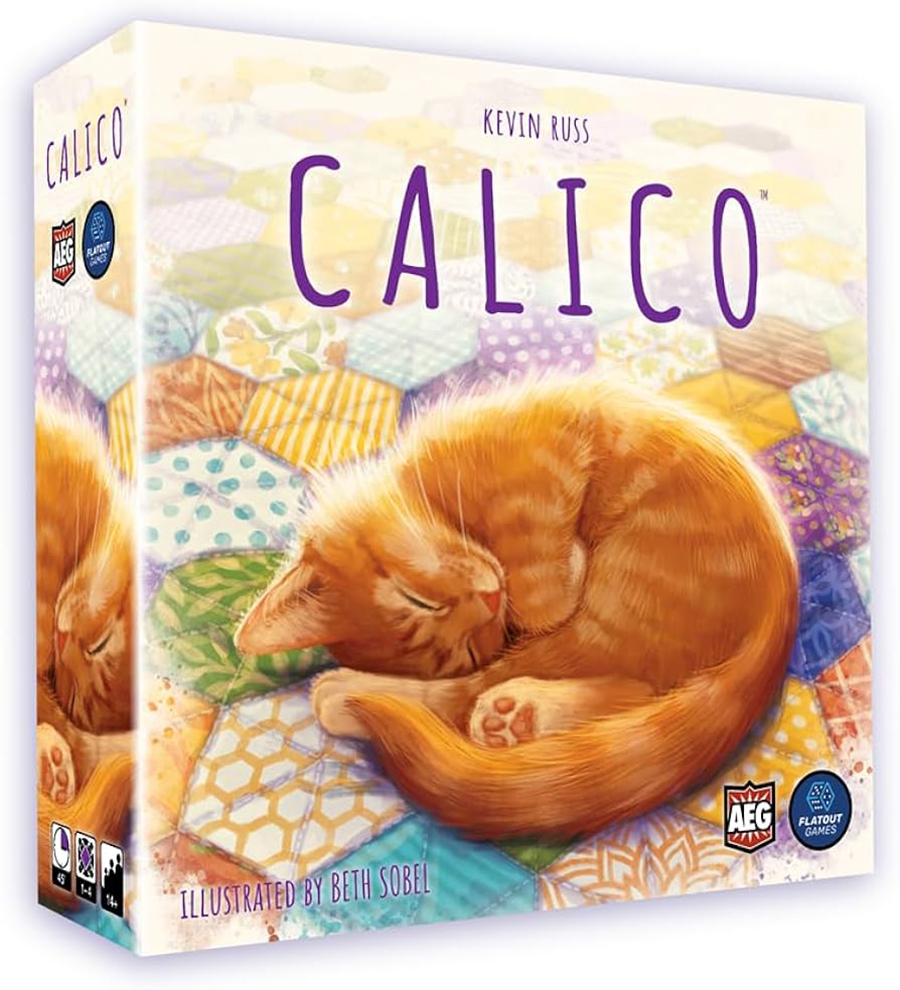
Calico is a puzzly tile-laying game of quilts and cats. In Calico, players compete to sew the coziest quilt as they collect and place patches of different colors and patterns. Each quilt has a particular pattern that must be followed, and players are also trying to create color and pattern combinations that are not only aesthetically pleasing, but also able to attract the cuddliest cats! Turns are simple. Select a single patch tile from your hand and sew it into your quilt, then draw another patch into your hand from the three available. If you are able to create a color group, you may sew a button onto your quilt. If you are able to create a pattern combination that is attractive to any of the cats, it will come over and curl up on your quilt! At the end of the game, you score points for buttons, cats, and how well you were able to complete your unique quilt pattern. —description from the publisher
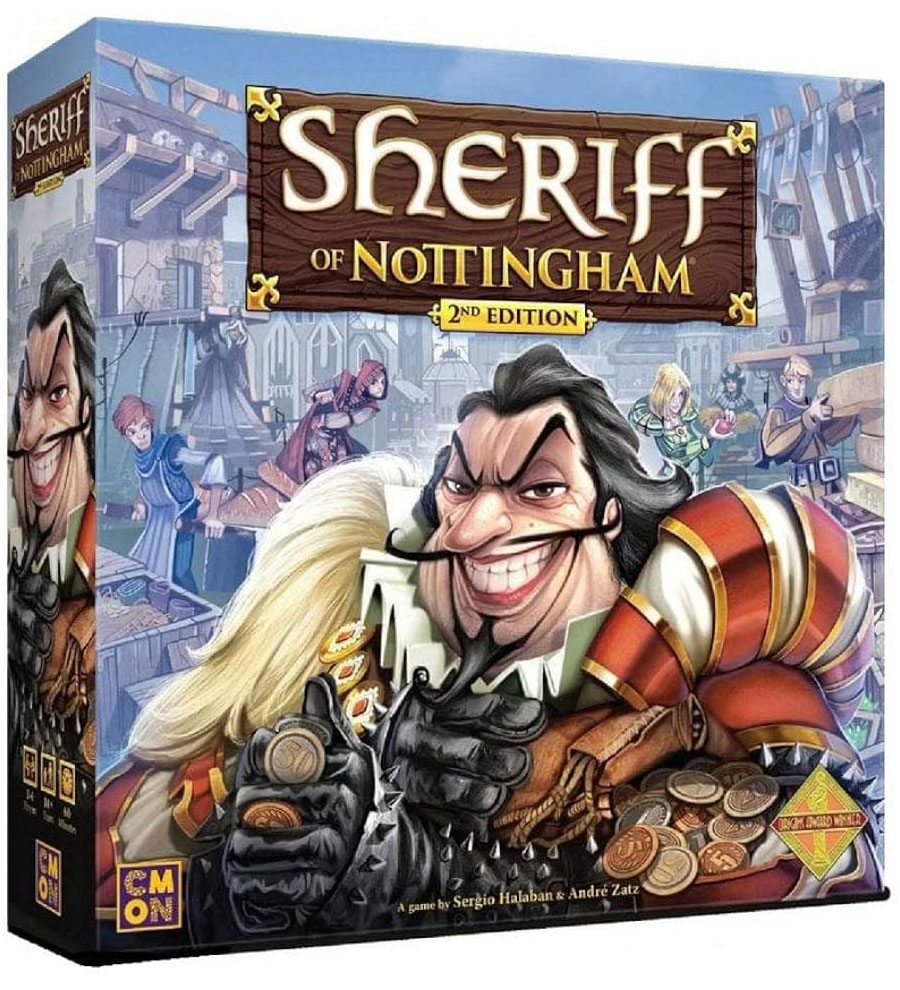
Will the Merchants get their goods past the Sheriff? The bustling market in Nottingham is filled with goods from all over the kingdom. Most of it is entirely legal, however, Prince John is looking to make sure no contraband gets sold. He’s tasked the Sheriff to inspect Merchant’s wares, looking for any illicit goods. The Sheriff’s shrewd, but not above taking a bribe to look the other way. Which Merchant will end up getting the best goods through and make the largest profits in the market stalls? In Sheriff of Nottingham 2nd Edition, players take turns playing the Sheriff, looking for contraband goods, and the Merchants trying to stock their Stall with the best goods. The Sheriff can inspect any bag they want, but they must be careful, as they’ll have to pay a penalty if they find the Merchants were telling the truth. This new edition includes updated rules, as well as expansions such as the 6th Merchant, Black Market, and Sheriff’s Deputies. The game box contains 110 Gold Coins, 216 Goods cards, 6 Deputy cards, 6 Black Market cards, 2 Deputy standees, 6 Merchant stands, 6 Merchant bags, a Sheriff standee, a Booty tile, and a rulebook
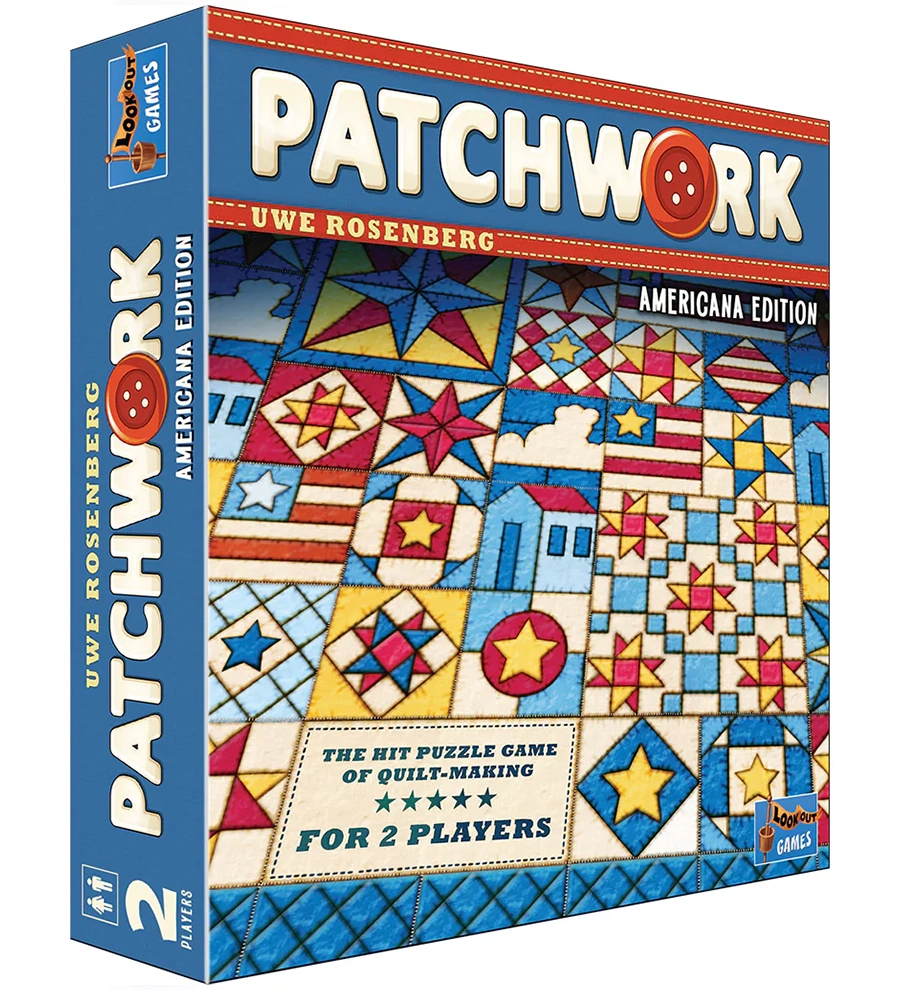
In Patchwork, two players compete to build the most aesthetic (and high-scoring) patchwork quilt on a personal 9x9 game board. To start play, lay out all of the patches at random in a circle and place a marker directly clockwise of the 2-1 patch. Each player takes five buttons — the currency/points in the game — and someone is chosen as the start player. On a turn, a player either purchases one of the three patches standing clockwise of the spool or passes. To purchase a patch, you pay the cost in buttons shown on the patch, move the spool to that patch's location in the circle, add the patch to your game board, then advance your time token on the time track a number of spaces equal to the time shown on the patch. You're free to place the patch anywhere on your board that doesn't overlap other patches, but you probably want to fit things together as tightly as possible. If your time token is behind or on top of the other player's time token, then you take another turn; otherwise the opponent now goes. Instead of purchasing a patch, you can choose to pass; to do this, you move your time token to the space immediately in front of the opponent's time token, then take one button from the bank for each space you moved. In addition to a button cost and time cost, each patch also features 0-3 buttons, and when you move your time token past a button on the time track, you earn "button income": sum the number of buttons depicted on your personal game board, then take this many buttons from the bank. What's more, the time track depicts five 1x1 patches on it, and during set-up you place five actual 1x1 patches on these spaces. Whoever first passes a patch on the time track claims this patch and immediately places it on his game board. Additionally, the first player to completely fill in a 7x7 square on his game board earns a bonus tile worth 7 extra points at the end of the game. (Of course, this doesn't happen in every game.) When a player takes an action that moves his time token to the central square of the time track, he takes one final button income from the bank. Once both players are in the center, the game ends and scoring takes place. Each player scores one point per button in his possession, then loses two points for each empty square on his game board. Scores can be negative. The player with the most points wins.


ABOUT
STORE
NEWS
CONTACT
© 2012 - 2026 • Avada is a Website Builder for WordPress and eCommerce • All Rights Reserved • Developed by ThemeFusion